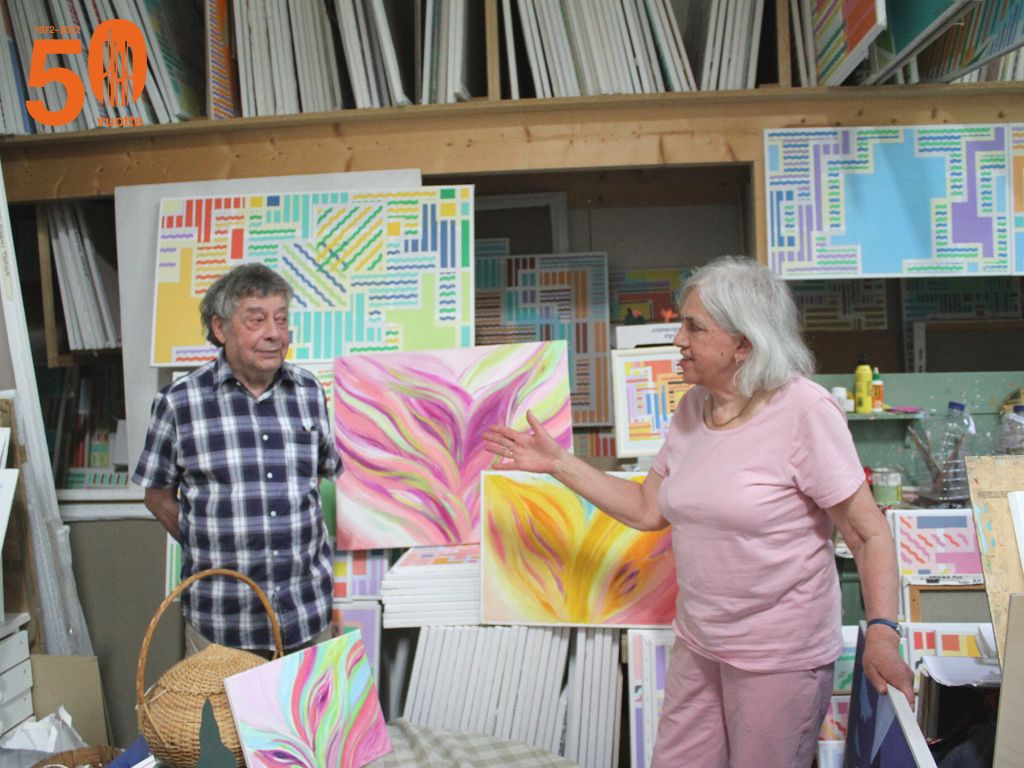
Caption: Exhibitions were held in Juhani and Marja Tarna's home as early as the 1970s. The then-market manager Ennu Virtanen also visited the exhibitions.
Kankaanpää is known as a vibrant art city. However, its identification as an art city did not happen overnight, and the art school founded in 1965 even aroused astonishment among contemporaries.
Born in Kankaanpää in 1937 Juhani Tarna loved drawing as a child. Drawing became a habit and as he grew older, his skills developed. The young artist ended up studying in Helsinki and after receiving a scholarship, Tarna also studied in France. When he returned to Finland, he brought with him a style that was not yet common.
– While studying in Finland, I had already begun to lean towards abstract painting, and my art studies in France strengthened my view of my own style. When I returned to Finland, I wanted to spread the good news of abstract art to everyone, but it wasn't easy, because the traditional painting style was very restrictive, Tarna recalls.
After completing his studies, Tarna organized the first purely abstract art course in Satakunta. During the course, he also met a young student from Panelia, Marjaan, who later became his wife.
Towards an art city
In 1965, Juhani Tarna founded the Kankaanpää Art School together with sculptor Remote Ratchet with. Marja Tarna began her studies in Kankaanpää right in the first year of art school. After Marja graduated, the Tarnas stayed in Kankaanpää.
In Kankaanpää in the 1970s, art was not yet part of the city's identity. Some art was sold, and for example, the former town manager, From Ennu Virtanen, became a friend of art. Virtanen also bought works by Tarno.
– For a novice and uncertain artist, it was a big deal. Ennu Virtanen also brought guests from the international week to exhibitions held at our home at that time, which was important for creating the image of an art city, says Marja Tarna.
Exhibitions were held in the 1970s both at the Tarno family home and, for example, in the premises of the art school that had recently moved. However, art collectors were never blessed with a presence in Kankaanpää. The only extensive art collection was the so-called Reima collection, which the then CEO of Reima Oy Heikki Lampinen collected, and which was later donated to the city of Kankaanpää. That collection also includes works by Tarno.
Art school students brought color to the street scene
The art school has brought young artists to Kankaanpää and also brought color to the street scene. Especially in the early years of the art school, the artists were left with a little bit of confusion and wonder. Fortunately, support was found and the art school gradually established its place in the field of art education throughout Finland.
– The students at the art school have never doubted that they would get “that something” here, says Juhani Tarna.
Although the artists caused wonder, Tarnoje says that there was never any malice associated with the wonder. Over the decades, attitudes have changed and wonder has turned into pride.
– When there was talk at one point about closing the art school, people were shocked. I remember when someone came up to me on the street to ask me what would be left of this city if art and artists were taken away from here, Marja Tarna laughs.
The art school and artists had already grown attached to them. Although the city's slogan is now "intelligence, art and well-being live with us," Tarnat calls for the importance of various supporters. Although times have changed, the profession of an artist has remained largely the same.
– To succeed as an artist, creativity, talent and determination are required. Education provides the artist with basic skills, but artistry is developed over time and one often has to do other jobs to earn a living, Marja Tarna summarizes.
Text and photo: Tytti Wallenius
The article has been published in collaboration with the Kankaanpää Region.