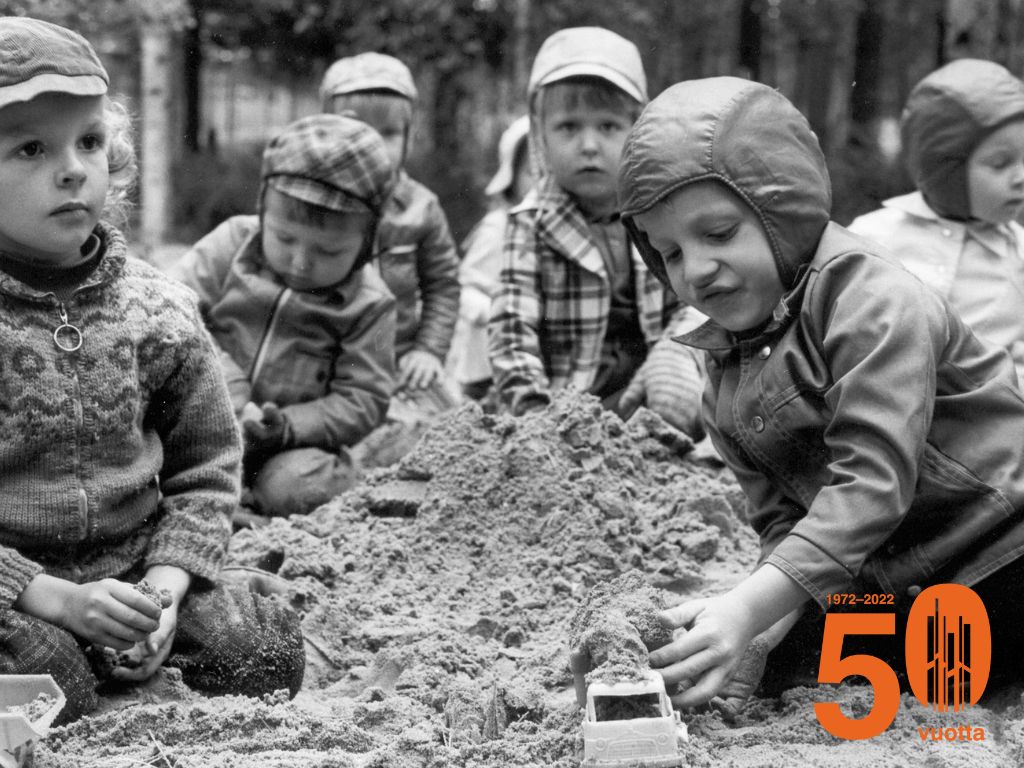
Caption: Children at the Asemakatu daycare center in the 1970s. The daycare center, now known as the Jalava daycare center, will celebrate its 50th anniversary in November.
Early childhood education became more common in the 1970s, when municipalities began to offer daycare options to working parents.
In the early 1970s, about 60 percent of married women worked. Childcare was expensive at the time and the availability of caregivers was uncertain, leading to a law in Finland providing daycare.
The Day Care Act came into force in 1973. At that time, day care was mainly seen as an opportunity for parents to work or study.
The first daycare center in Kankaanpää was the Reimankallio private daycare center, which was intended specifically for the children of Reima factory workers. It opened its doors in August 1972, with a total of 25 places. A little later that year, the Asemakatu daycare center, now known as Jalava Daycare Center, was also opened, which was maintained by the city.
More new daycare centers were opened later. In 1974, both Myllymäki and Niinisalo daycare centers opened their doors. Today, there are a total of six municipal daycare centers and two private service voucher daycare centers in Kankaanpää.
In the 1990s, daycare became a subjective right. For the first time, all children had the right to a place to care for them, regardless of whether their guardians were working or not. Instead of daycare, people also started talking about early childhood education. Early childhood education is a systematic and goal-oriented activity that emphasizes pedagogy.
– That planning and goal-setting is perhaps the biggest change in the past decades. There was planning before, of course, but it was mainly based on activities carried out in groups. Nowadays, activities are planned more based on the needs of the children. This way, the activities are more individualized and better support the development of the children, Kankaanpää City Early Childhood Education Manager Maria Saimala describes.
Current activities are guided by the Early Childhood Education Act and the principles of the Early Childhood Education Plan. The plan can be supplemented by taking into account local needs and resources. In Kankaanpää, the planning has taken into account, among other things, excellent cultural and sports opportunities.
– Cooperation with homes has always been very active. We have met with guardians and continue to meet them daily, which creates a good foundation for cooperation. I personally see this as a strength of early childhood education. Supporting homes and confidential cooperation is the best support for a child's development, says Saimala.
From the perspective of children in Kankaanpää, one of the biggest changes is the increase in the size of early childhood education units. There are now only three daycare centers with one group, and the number of family daycare workers has decreased to less than twenty. Today, the largest daycare center has a total of nine groups. Back in the 1980s and 90s, the focus was clearly on family daycare, and in Kankaanpää there were more than three times as many caregivers.
Nurse sizing has also changed. Previously, group size was not regulated by staffing, as is done today.
Although many things have changed, one thing remains the same: children.
– Working with children is rewarding, and the feedback you get from them is always immediate and honest. When working with children, you always get direct feedback on how well you have done.
Text: Tytti Wallenius
Photo: Leena Perälä / Kankaanpää City Museum photo collection
The article has been published in collaboration with the Kankaanpää Region.